
Local Currency Sales Support focuses on the payment and collection activities involved in selling in China. It is an integral part of PTL Group’s Trading Services in China, which manage the broader commercial, regulatory, and operational requirements of the transaction. Many Chinese companies prefer to buy from a local supplier, pay in Yuan (RMB), and receive an official Chinese tax invoice. Foreign-currency payments and complex cross-border procedures can make purchasing more difficult and discourage buyers from completing the transaction.
PTL Group supports two models. Companies without a Chinese entity can conduct local transactions through a PTL Group entity. For companies with a Chinese subsidiary, our finance and operations teams strengthen local billing, collection, credit control, and overseas fund transfers.
Both models give customers a familiar purchasing process while providing headquarters with clearer financial control and reliable local execution.
Selling in China using a Letter of Credit? Read this.
Who Is This Service Designed For?
Local Currency Sales Support is designed for international companies that:
- Sell in China (products, software, services, SaaS, or training) and need RMB payment terms, an official e-Fapiao, local payment collection, and overseas settlement.
- Want to develop local sales before establishing a Chinese entity.
- Operate a Chinese subsidiary and need stronger billing, collection, financial control, or overseas fund transfers.
- Need payment-controlled inventory release within local fulfillment operations.
- Want stronger credit control by linking customer payments to inventory management.
- Require clear transaction records and reporting for overseas headquarters.
Which Local Currency Sales Model Fits Your China Operation?
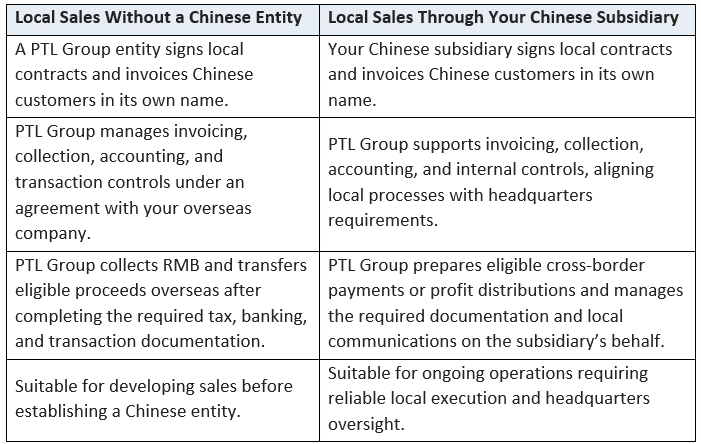
.
Before either model is implemented, PTL Group reviews the Chinese customer’s corporate background to identify potential compliance, credit, or reputational risks. Both models involve transaction-specific tax, banking, foreign-exchange, and regulatory requirements. PTL Group coordinates the documentation, approvals, and communication with banks, tax authorities, the State Administration of Foreign Exchange (SAFE), and other relevant local authorities.
How Can You Manage Local RMB Sales Through PTL Group?
What Does the RMB Billing and Collection Process Include When Selling Through PTL Group?
For companies selling in China through a PTL Group entity, the process typically includes the following stages, subject to the transaction’s requirements:
- Transaction assessment: We review the product or service, contract structure, payment terms, taxes, licensing, and required documents.
- Local contracting: A PTL Group entity signs an RMB sales agreement with the Chinese buyer and a corresponding agreement with your overseas company.
- Inventory release: For product sales, PTL Group can link product release and delivery to the agreed payment status.
- Invoicing and collection: PTL Group issues the applicable e-Fapiao and collects the customer’s RMB payment.
- Cross-border settlement: After applicable costs, taxes, and documentation are completed, the proceeds are converted and transferred to your overseas corporate account.
Need a Local Trading Party in China?
Learn how PTL Group coordinates contracts, licenses, customs procedures, VAT documentation, logistics, and transaction execution through our Trading Services in China.
How Does PTL Group Support China Subsidiary Billing and Collection?
A Chinese subsidiary usually signs local contracts, invoices customers, receives RMB payments, and records transactions in its own accounts. PTL Group can serve as its outsourced local finance and operations team, working with overseas management.
Support may include:
- Reviewing sales contracts, invoicing procedures, and payment terms
- Managing e-Fapiao issuance and transaction records
- Accounts receivable management in China, including payment monitoring and credit exposure
- Coordinating accounting, VAT, tax filings, and management reporting
- Preparing eligible cross-border payments or profit distributions
- Connecting payment control with inventory and delivery
This strengthens headquarters oversight while keeping local commercial, financial, and operational processes aligned.
How Are e-Fapiao Requirements Managed?
A Fapiao is China’s official tax invoice and part of the compliance record for a domestic transaction. Chinese B2B buyers commonly need it to process payments, maintain accounting records, and, where applicable, claim input VAT deductions.
For transactions conducted through PTL Group, the relevant PTL Group entity issues the invoice. For sales through a client’s Chinese subsidiary, PTL Group supports the entity’s invoicing procedures and controls. Our team can manage:
- The appropriate invoice type
- Alignment among contracts, invoices, payments, and delivery records
- Secure storage and retrieval of original digitally signed XML invoice files for at least 10 years, or longer where applicable accounting-archive rules require
- Invoice controls and supporting tax and audit documentation
Invoice type, VAT treatment, and documentation depend on the transaction. PTL Group assesses these requirements before execution.
How Are Funds Transferred to the Overseas Company?
Cross-border transfers are reviewed by local banks under China’s foreign-exchange framework, overseen by the State Administration of Foreign Exchange (SAFE). Banks may require contracts, invoices, tax records, delivery or acceptance evidence, and other documents supporting the payment.
The transfer route depends on the operating model:
- Settlement through PTL Group: Once applicable taxes are settled and documentation and bank requirements are met, PTL Group transfers the eligible transaction proceeds to the overseas company under the corresponding agreement.
- Transfer from a Chinese subsidiary: The appropriate route may include service fees, royalties, reimbursements, or dividend-based profit repatriation, each with its own contractual, tax, audit, and regulatory requirements.
Dividend-based profit repatriation generally requires the subsidiary to complete its annual audit and tax procedures, cover applicable prior losses, and meet statutory reserve and distribution requirements. Withholding tax and treaty provisions may affect the amount transferred.
PTL Group coordinates the documentation, tax treatment, and banking process for either route. Timing, currency availability, and bank approval remain subject to the transaction and applicable requirements.
How Does 4PL Logistics Strengthen Credit Control?
For physical products held in PTL Group facilities, payment status can be linked directly to inventory release. Under the agreed commercial terms, goods can be released after payment is secured or received, combining financial control with physical control over fulfillment and delivery.
Need Local Logistics and Distribution Support in China?
Learn how PTL Group manages warehousing, inventory, order fulfillment, and nationwide distribution through our Logistics, Fulfillment & Distribution Services in China.
Why Choose PTL Group for Local Currency Sales Support?
PTL Group combines local trading, financial management, and 4PL logistics within one operational framework. We coordinate contracts, invoices, payments, inventory, delivery, and overseas transfers, whether sales are conducted through PTL Group or the client’s Chinese subsidiary.
Key business benefits include:
- Support at each stage: Conduct transactions through PTL Group before establishing an entity, or strengthen an existing subsidiary.
- Easier purchasing: Local contracts, RMB payments, and compliant invoicing reduce buyer friction.
- Stronger financial control: Coordinate invoicing, collection, documentation, and reporting through one team.
- Connected logistics and credit management: Link inventory release to payment conditions.
- Clearer headquarters visibility: Receive structured transaction records and coordinated financial reporting.
Q&A About Local Currency Sales in China
Can we invoice customers in China without registering a local company?
Yes. For eligible transactions, a PTL Group entity signs the domestic sales contract, issues the applicable e-Fapiao, and collects the RMB payment. A corresponding agreement with your overseas company allows the transaction to proceed without your own Chinese subsidiary.
Can PTL Group support our existing Chinese subsidiary?
Yes. PTL Group can support local contracts, invoicing, collection, accounting, tax coordination, credit control, and management reporting. We can also prepare eligible cross-border payments or profit distributions to the overseas parent.
Read more about Financial Management & Accounting services in China.
Can PTL Group issue a compliant VAT e-Fapiao for our sale?
PTL Group can issue the appropriate invoice for transactions conducted through its relevant local entity. Invoice type and VAT treatment depend on the product or service, transaction structure, and buyer requirements.
How should original e-Fapiao XML files be stored?
PTL Group stores and retrieves the original digitally signed XML files for e-Fapiao issued through its entity. These files should be retained for at least 10 years, or longer where applicable accounting-archive rules require. We also align each invoice with the relevant contract, payment, and supporting documents.
How are collected RMB funds transferred overseas?
For transactions conducted through PTL Group, proceeds are settled with the overseas supplier under the corresponding agreement. For sales through a client’s Chinese subsidiary, PTL Group helps document the appropriate route, including service fees, royalties, reimbursements, or dividend-based profit repatriation. All transfers remain subject to their commercial basis, tax treatment, bank review, and foreign-exchange rules.
Can payment collection be connected to inventory management?
Yes. When PTL Group manages warehousing and fulfillment, payment status can be linked to product release, providing coordinated financial and physical control.
Can this service support sales of services, software, or training?
Yes, subject to the service, contract structure, tax treatment, and supporting documents. PTL Group can manage eligible local service transactions, collect RMB, issue the relevant invoice, and arrange overseas settlement.