
Trading in China can require a locally registered party with the appropriate business scope, licenses, tax status, customs capabilities, and banking arrangements. These requirements affect who can sign the contract, import or purchase the goods, issue the required transaction documents, manage delivery, and complete the sale or export.
PTL Group can act as the local trading party for eligible transactions and coordinate the commercial process from contract review through customs, logistics, VAT documentation, and final delivery. The model can support international companies before they establish a Chinese entity, as well as companies that need an additional licensed trading structure for specific products or transactions.
Trading Services focus on how the transaction, goods, licenses, and regulatory requirements are managed. When the primary need is RMB invoicing, payment collection, accounts receivable management, or overseas fund transfer, our Local Currency Sales Support provides the complementary financial framework.
Who Are Trading Services Designed For?
PTL Group’s Trading Services are designed for international companies that:
- Need a local trading party to purchase or sell goods in China.
- Want to import products without using their own Chinese entity as the Importer of Record (IOR).
- Purchase from Chinese suppliers and need local contracts, local payments, consolidation, or export coordination.
- Require product-specific licenses or permits for importation or local sales.
- Need customs, VAT, and logistics coordination under one transaction framework.
- Work with original equipment manufacturers (OEMs) and want a commercial buffer between suppliers and customers.
- Manage warranty, demonstration, loan, return, or RMA flows that require controlled local dispatch and documentation.
What Do PTL Group’s Trading Services Include?
Local Sales, Import and Distribution Compliance
- Import and sales licensing: Assess and coordinate the licenses and permits required for the product and transaction.
- Importer of Record support: Import eligible products through the appropriate PTL Group entity and customs registration.
- Local commercial contracts: Sign the required purchase and sales agreements with suppliers, customers, or other transaction parties.
- Consignment trading: Support eligible consignment structures for products sold in China.
- Customs and VAT documentation: Coordinate declarations, import records, transaction documents, and applicable tax documentation.
- Order and return flows: Arrange controlled dispatch for warranty, loan, demonstration, return, and Return Merchandise Authorization (RMA) purposes.
Procurement and Export Coordination
- Local purchasing: Purchase goods, parts, or raw materials from Chinese suppliers under RMB agreements.
- Supplier coordination: Manage purchase orders, delivery schedules, supporting documents, and consolidated receipt of goods.
- Export execution: Coordinate export documentation, customs procedures, freight, and delivery to the overseas destination.
- Export VAT refund support: Prepare and manage eligible refund applications and the required supporting records.
E-commerce Trading Support
For eligible e-commerce models, PTL Group can support the local trading structure, transaction records, product flows, and financial coordination required to connect online orders with compliant fulfillment.
How is a Trading Transaction Managed?
- Transaction assessment: Review the products, parties, transaction route, Incoterms, business scope, licenses, taxes, and documentation requirements.
- Commercial structure: Define the roles of PTL Group, the overseas company, suppliers, customers, and logistics providers.
- Contracts and licenses: Prepare the required local agreements and confirm that the relevant entity can legally execute the transaction.
- Goods and customs coordination: Manage purchasing or importation, customs declarations, warehousing, and the required product records.
- VAT and transaction documentation: Align contracts, customs documents, invoices, delivery records, and accounting support.
- Delivery or export completion: Coordinate local distribution or overseas export and close the transaction under the agreed commercial framework.
- Payment and settlement support: When a transaction also requires local RMB invoicing, collection, or cross-border settlement, PTL Group can connect the trading process with its Local Currency Sales Support.
Need support with compliant import and export operations, customs clearance, warehousing, or commercial distribution? Explore our 4PL Logistics Services in China.
How Does China’s 2026 VAT Law Affect Trading Transactions?
China’s Value-Added Tax (VAT) Law and its Implementation Regulations took effect on January 1, 2026. For international companies trading in China, the practical impact extends beyond the VAT rate itself. Contracts, transaction logic, customs records, deduction documents, invoice flows, and internal controls must support the VAT treatment applied. This is particularly important for mixed transactions involving goods and services, customs import VAT certificates, and export VAT refund claims. Incomplete or inconsistent supporting records can affect deductions, refunds, pricing, and the defensibility of the company’s tax position.
For transactions conducted through PTL Group, the relevant local entity coordinates the applicable VAT documentation, filings, customs records, and supporting transaction files. The precise VAT treatment depends on the goods or services, contract structure, transaction route, and current regulatory requirements.
Read more: China’s 2026 VAT Reform: What International Companies Should Check Now
Which Trading Scenarios Can PTL Group Support?
Importing and Selling Overseas Products in China
- Business need: An international company wants to sell imported products to Chinese customers but does not have a suitable local entity or import license.
- PTL Group support: The appropriate PTL Group entity can serve as the local trading and importing party, coordinate product licensing and customs clearance, sign the domestic sales contract, manage VAT documentation, and connect the transaction with local warehousing and delivery.
Protecting Customer Relationships When Working with OEM Suppliers
- Business need: A company purchases locally manufactured products while maintaining direct commercial relationships with its Chinese customers.
- PTL Group support: PTL Group can act as an independent trading intermediary, purchasing from the original equipment manufacturer and selling to the designated customer under separate agreements. The structure reduces unnecessary exposure of supplier and customer information and supports clearer control of the commercial relationship.
Purchasing Parts from Multiple Chinese Suppliers
- Business need: Parts or raw materials are sourced from several Chinese suppliers under different delivery schedules and local RMB terms. Some suppliers may lack the required export capabilities or licenses, while China’s 2025 import-export regulations require transparent, traceable documentation identifying the actual suppliers and manufacturers.
- PTL Group support: PTL Group can act as the licensed local purchasing and exporting party, sign RMB purchase agreements, coordinate and consolidate supplier deliveries, maintain the required transaction records, complete export declarations, and prepare eligible VAT export refund documentation.
Assembly and Export Through an OEM Factory
- Business need: Components sourced in China and overseas must be delivered to a Chinese factory for assembly before local sale or export.
- PTL Group support: PTL Group can coordinate importation, local purchasing, delivery to the factory, assembly-related contracts, supporting records, and the subsequent domestic sale or export transaction.
Industry-Specific Import and Sales Requirements
- Business need: Regulated products – including medical devices and cosmetics (NMPA), electrical equipment (CCC), and food and beverages (GACC) – may require specific registrations, certifications, licenses, or sales permits.
- PTL Group support: PTL Group assesses the transaction requirements and, where eligible and within the relevant entity’s approved business scope, coordinates the required licensing and compliant trading route.
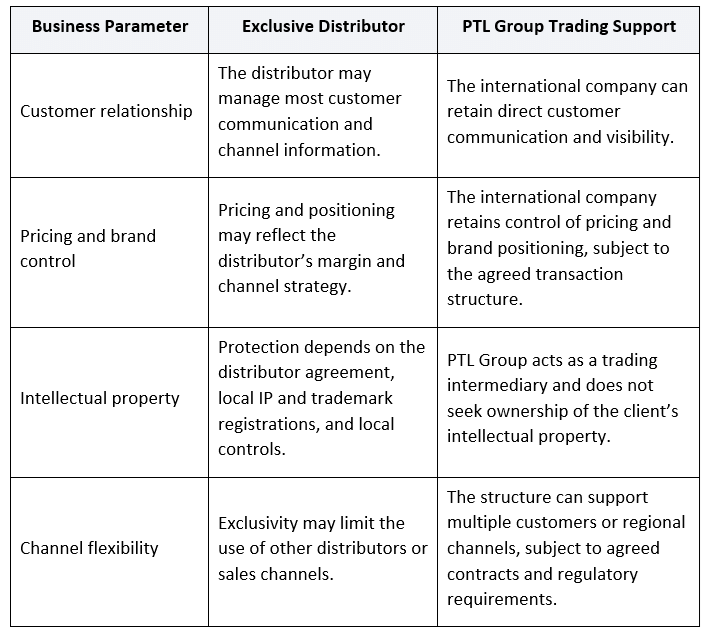
Exclusive Distributor or Independent Trading Support?
An exclusive distributor and an independent trading service perform different commercial roles. The appropriate model depends on the company’s sales strategy, desired level of control, and local operating needs.
Why Choose PTL Group as Your China Trading Partner?
PTL Group combines local trading capabilities with finance, tax, customs, and 4PL logistics support. This multidisciplinary structure provides a clearer view of the complete transaction and reduces coordination gaps among separate local suppliers.
- One coordinated transaction framework: Connect commercial agreements, regulatory requirements, documentation, goods, and delivery.
- Local execution: Work with China-based trading, finance, customs, and logistics teams.
- Flexible operating models: Use PTL Group as the local trading party where required or add specific capabilities to an existing China operation.
- Headquarters visibility: Maintain structured transaction records and clearer oversight of local execution.
Q&A About Trading Services in China
Can we trade in China without registering our own company?
For eligible transactions, an appropriate PTL Group entity can act as the local trading party. The structure depends on the products, transaction route, licenses, tax treatment, and required documentation.
What is the difference between Trading Services and Local Currency Sales Support?
Trading Services manage the commercial, regulatory, and operational execution of the transaction, including goods, suppliers, licenses, customs, VAT documentation, and logistics. Local Currency Sales Support focuses on invoicing customers, collecting RMB payments, managing receivables, and transferring eligible funds overseas.
Can PTL Group act as the Importer of Record in China?
For eligible products and transactions, the appropriate PTL Group entity can serve as the Importer of Record and coordinate import licensing, customs clearance, VAT documentation, and local delivery.
Can PTL Group purchase from several Chinese suppliers and export the goods?
Yes, where the transaction is eligible. PTL Group can coordinate local purchase agreements, supplier deliveries, consolidation, export documentation, customs procedures, and applicable VAT refund support.
Can PTL Group obtain every product license?
Licensing depends on the product category, transaction structure, regulatory requirements, and the approved business scope of the relevant entity. PTL Group assesses these requirements before confirming the trading route.
What Is the Difference Between a China Trading Company and a Sourcing Agent?
Sourcing and drop-shipping agents typically focus on supplier identification, procurement coordination, fulfillment, and shipping. A China trading company can also serve as the local commercial party to the transaction, coordinating contracts, import and sales licenses, customs procedures, VAT documentation, local delivery, and transaction execution. Where required and eligible, PTL Group can perform this role without the overseas company establishing its own entity in China.
How Does China’s 2026 VAT Law Affect Foreign Companies Selling into China Without an Entity?
China’s VAT Law and its Implementation Regulations, effective January 1, 2026, place greater emphasis on the contracts, customs records, invoices, and supporting documents used to substantiate the VAT treatment of a transaction. For eligible sales, the appropriate PTL Group entity can act as the local trading and importing party, coordinating customs procedures, VAT documentation, applicable filings, and compliant invoicing. The precise requirements depend on the products or services, transaction structure, and trading route.
More information about Trading Services in China
- Tapping into Chinese Market Potential: The Many Benefits of Trading Services in China
- Haven’t Registered an Entity in China? You Can Still Build Your Local Business
- Outsourcing Supply Chain Management: Make Your China Business Work Better
- Everything You Need to Know (and Weren’t Told) About Industrial Parks in China