China’s 15th Five-Year Plan offers international companies an early signal of how the business environment is changing and what management teams should review next.
Table of Contents:
- From Strategic Shift to Practical Execution
- A More Coordinated Business Environment
- Infrastructure for the Next Industrial Cycle
- Selective Openness
- Compliance Takes Center Stage
- Implications for International Companies
- Q&A about China’s 15th Five-Year Plan
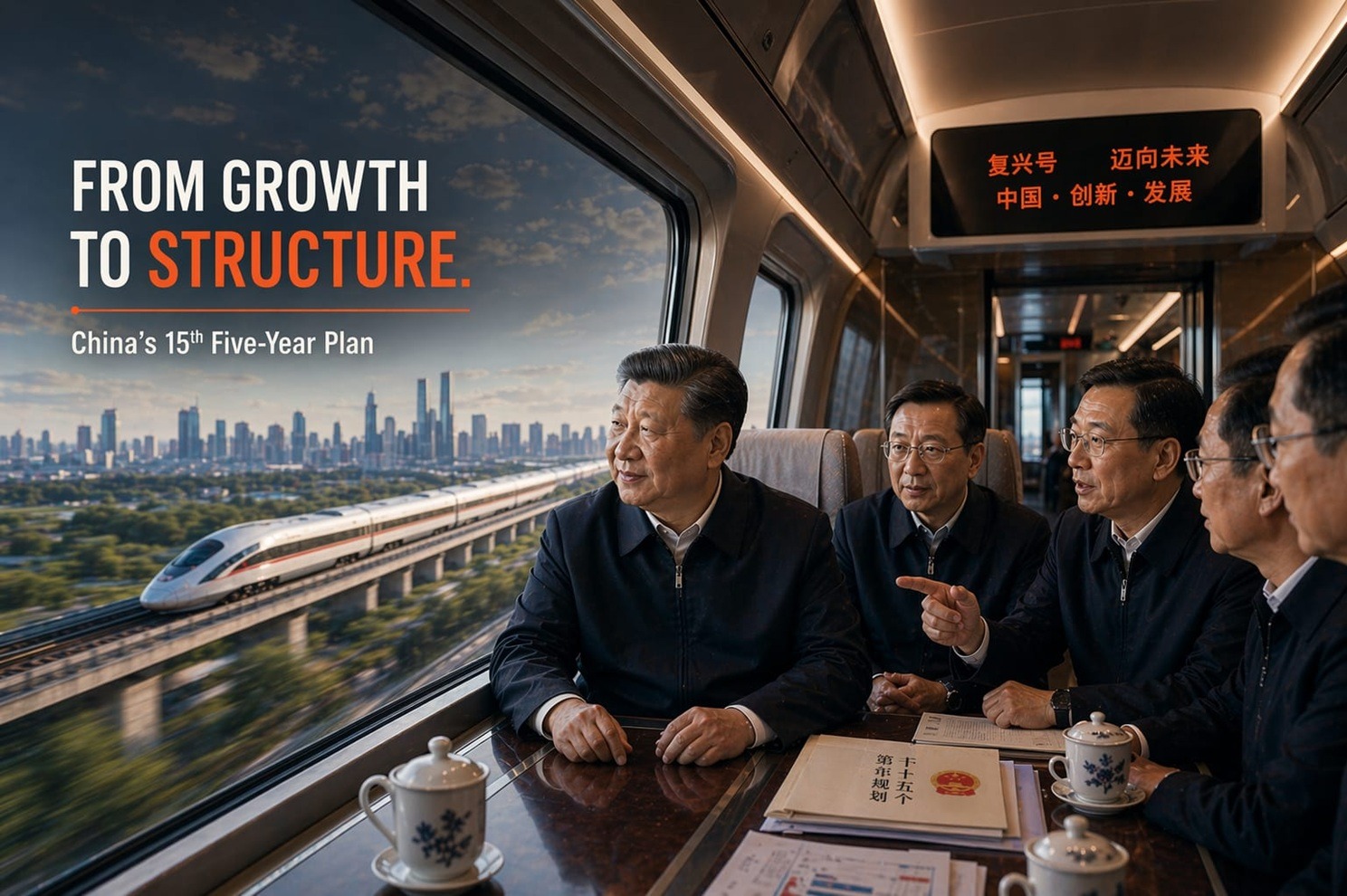
Image done by AI
From Strategic Shift to Practical Execution
China is known for its long-term goal setting. The majority of us are familiar with the five-year plans, but if you follow things carefully, you will find other plans spanning from a couple of years to decades, that provide an underlying general agenda for which the five-year plans usually highlight the methods China decides to adopt based on actual internal and external forces.
The 14th Five-Year Plan, introduced in 2021, for example, was a product of the COVID era and focused on adapting to the growing disruption and rising uncertainty in U.S.-China relations. While that plan signaled a shift toward self-reliance, the 15th Five-Year Plan, published in March this year, builds on the 14th Plan but is also deeply connected to those broader long-term plans and the underlying tone established previously. It reads less like a transition document (which was associated with the 14th plan) and more like a deliberate plan for execution in a world shaped by geopolitical instability and a slower domestic momentum. It is characterized as a practical roadmap for execution and structured delivery.
Companies that still expect high growth in their China-operated businesses should now officially change that view. If you saw the shift happening already in the last few years, the 15th plan tells you that the Chinese government is now acknowledging it, too.
A More Coordinated Business Environment
Though not a new idea, this plan emphasizes the shift in which China is no longer focused solely on “how much” growth to generate, but on how policy, capital, and implementation are organized to secure stability. In this plan, we see a call to Whole-System Modernization, an integrated national goal involving modernization across all parts of the system, including governance quality and coordinated delivery. If we are used to a sectoral approach, leaving decisions on how and what to local, provincial or city levels, the 15th plan aims to create a national standard and bar for everyone. One thing we started seeing already is the move toward a coordinated regulatory environment that is more aligned across different agencies and levels.
Operations-wise, foreign-owned companies doing business in China will have to carefully watch where and how regulations change. While in the past there could be completely opposite regulations across different provinces, this might gradually change over the next five years.
Infrastructure for the Next Industrial Cycle
China is returning to its historical tool of using major infrastructure projects for development, but this time, we can expect more upgraded and modernized projects than the old ghost cities. Infrastructure is recast as a platform for industrial and technological upgrading, specifically tied to the next industrial cycle.
These foundations are designed to support China’s future plans in technology, from AI development to space innovation. Projects involve smarter systems, grid upgrades, energy storage, data infrastructure, and computing power, alongside roads and other logistics projects. And all are connected to the goals of self-reliance and resilience.
Where the opportunity for foreign-owned businesses lies remains to be seen, but China is no longer only the factory of the world, and definitely doesn’t want others to view it as such anymore.
Selective Openness
The plan maintains the language of openness, and though China is looking more inwards, the official agenda is to promote openness and foreign investment. But China is becoming more strategically welcoming to foreign companies that support Chinese priorities, strengthen the local ecosystem, or fill strategic gaps. Companies in targeted strategic sectors will enjoy easier access and greater “active openness,” while others may receive less attention, though they are not prohibited from operating. The promoted industries mentioned in the 15th plan are vast, as China is seeking technology leadership, but they can be summarized into 4 groups Digital and intelligent technologies (such as AI, semiconductors, robotics). Advanced industrial capabilities (like smart manufacturing), Green and energy transition and Life sciences and health-related technologies
Success, now, depends on being relevant to the country’s next phase of development and aligning with national priorities. And though no one will reject your WFOE setup if you are not part of the above categories, the environment for those is matured and local competition might be tight.
Compliance Takes Center Stage
The impact of the 15th Plan extends to the day-to-day operating environment, which is becoming more closely aligned and monitored. Doable more now than before, after achieving the plan to become a digital-first country, systems are now all online and integrated, which enables the creation of a national one-standard monitoring system. Customs, local business and tax systems are all connected now, allowing greater visibility to any company’s operations. This is a great sign to anyone who wants to run a due diligence check on a potential buyer or partner, but it also requires higher levels of compliance than before.
Foreign-owned businesses must ensure that their business operations, reporting practices, compliance standards, and workflows align with this path. Some parts of this are already visible in the new export law, the new VAT law, the latest company law, and relevant updates to cybersecurity regulations, to name a few. If you haven’t gone through an internal due diligence process (operational audit) lately, now is the time to do so.
Implications for International Companies
China’s 15th Five-Year Plan offers international companies a clearer view of where the country as a whole, and the market are heading. The signal is clear: China’s operating environment is becoming more structured, more selective, and more tightly coordinated across policy, regulation, and implementation.
For management teams, this means looking beyond growth plans alone. Companies that sell, source, manufacture, or invest in China should assess whether their current operating model is suited to the environment ahead, from local structure and partner arrangements to compliance processes and internal visibility across HR, finance, tax, customs, and daily operations.
China continues to offer substantial opportunities, but success will increasingly favor companies that are well prepared, operationally disciplined, and equipped to operate within a more structured local framework. PTL Group supports international companies in China with the operational, financial, and compliance infrastructure needed to meet local requirements and move forward with confidence. Contact us to discuss how we can support your business.