China’s Foreign Investment Negative List is one of the first regulatory documents international companies should review before establishing or expanding operations in China. It identifies sectors that are open to foreign investment, restricted, or prohibited.
As of 2026, the applicable nationwide list remains the Special Administrative Measures for Foreign Investment Access (Negative List), 2024 Edition, effective from November 1, 2024.
Contents
- What Is China’s Foreign Investment Negative List?
- What Changed Under the 2024 Edition?
- Which Sectors Remain Restricted or Prohibited?
- Why Is the Negative List Only the Starting Point?
- What Should International Companies Check Before Incorporating in China?
- How Can PTL Group Support Your China Market Entry?
.
Key Takeaways
- The 2024 Foreign Investment Negative List remains the applicable nationwide list in 2026.
- Nationwide restrictions on foreign investment in manufacturing have been removed.
- Restrictions remain in sectors including telecommunications, education, healthcare, media, culture, and other sensitive activities.
- Companies must also review licensing requirements, market-access rules, and location-specific pilot policies before establishing operations in China.
What Is China’s Foreign Investment Negative List?
The Foreign Investment Negative List identifies industries in Mainland China where foreign investors face restrictions or prohibitions. It is issued by the National Development and Reform Commission (NDRC) and the Ministry of Commerce (MOFCOM).
If an activity appears on the list, foreign investment may be prohibited or permitted only under specified conditions, such as foreign equity caps, Chinese controlling ownership, or joint venture requirements.
If an activity does not appear on the list, foreign investors are generally treated in the same way as domestic investors for market-entry purposes, subject to other applicable regulations.
This review should take place before a company commits to a local structure or decides how to enter the Chinese market. A business activity may appear commercially attractive, but the applicable access rules can directly affect whether and how it may be carried out in China.
What Changed Under the 2024 Edition?
The 2024 edition reduced the nationwide Foreign Investment Negative List from 31 to 29 entries by removing the final two manufacturing-related restrictions. These concerns:
- Chinese controlling ownership in the printing of publications.
- Certain processing techniques and confidential formulations relating to traditional Chinese medicine products.
As a result, manufacturing is no longer restricted under the nationwide Foreign Investment Negative List.
For international manufacturers, this creates broader options for establishing production, assembly, processing, or supply-chain operations in China. Restrictions remain, however, in several service sectors and sensitive industries.
Which Sectors Remain Restricted or Prohibited?
Although manufacturing has been opened nationally, foreign investors still need to examine the specific rules affecting their intended business activity.
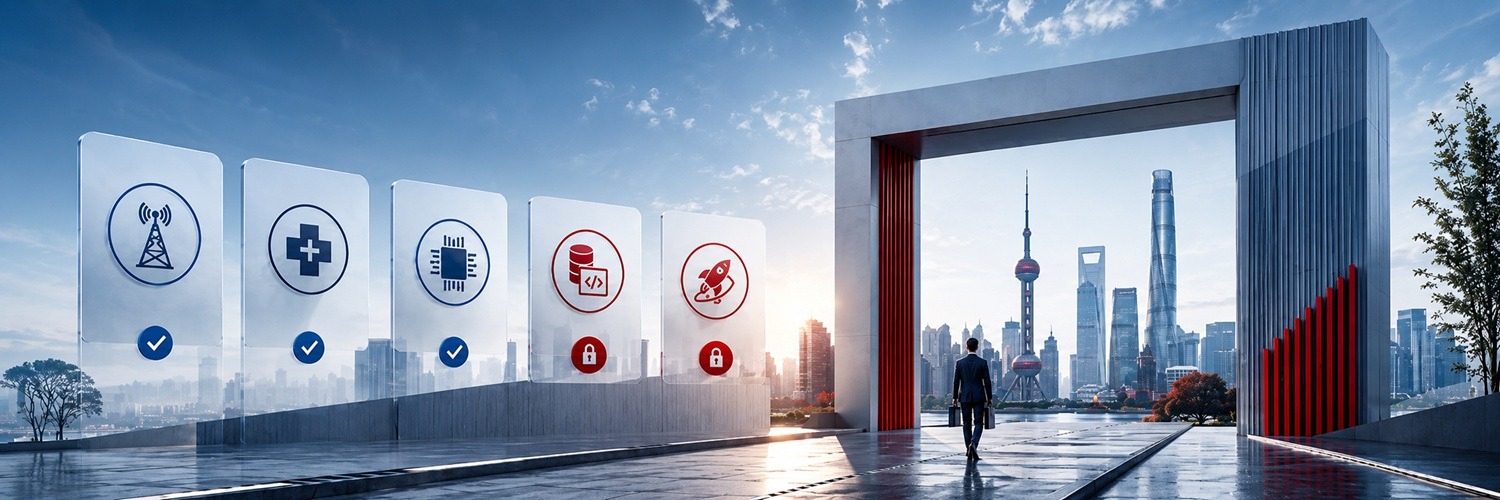
- Telecommunications and Digital Services
Basic telecommunications businesses must remain Chinese-controlled. In most value-added telecommunications services, foreign ownership remains capped at 50 percent.
Pilot measures allow wider foreign participation in certain value-added telecommunications services in designated locations. Companies should therefore examine both the classification of their service and the geographic scope of any applicable pilot policy.
- Healthcare and Education
Medical institutions remain subject to joint venture requirements under the nationwide list.
Foreign investment in certain education institutions also remains restricted. Pre-school, ordinary high school, and higher education institutions must meet joint venture and Chinese-led requirements, while compulsory and religious education institutions remain prohibited.
Pilot policies concerning wholly foreign-owned hospitals in selected locations may provide opportunities. However, these measures do not remove the nationwide restrictions.
- Media, Culture, and Other Sensitive Activities
Foreign investment remains prohibited or restricted in several media and cultural activities, including news organizations, publishing, radio and television, film production and distribution, and performing arts groups.
Restrictions also remain in sensitive fields such as rare earth mining, certain genetic and human stem cell technologies, tobacco products, surveying and mapping, and domestic express mail delivery.
Why Is the Negative List Only the Starting Point?
A sector that does not appear on the Foreign Investment Negative List is not necessarily free from regulatory requirements.
International companies should also review the Market Access Negative List, which applies to both domestic and foreign investors. The 2025 edition reduced this separate list from 117 to 106 items.
An activity may therefore be open to foreign ownership but still require permits, licenses, approvals, or compliance with sector-specific rules.
Companies should also examine the Catalogue of Encouraged Industries for Foreign Investment. The 2025 edition became effective on February 1, 2026, expanding encouraged investment categories in areas such as advanced manufacturing, high-tech industries, modern services, energy conservation, and environmental protection.
The Encouraged Catalogue does not replace the Negative List. It identifies sectors where foreign investment may benefit from policy support or incentives, while the Negative List identifies restrictions and prohibitions.
In addition, Pilot Free Trade Zones and other designated areas may provide opportunities that are not available nationwide. Location should therefore be considered before deciding where and how to establish operations.
Regulatory review is only one part of China market-entry preparation. Companies should also consider how their brand, product name, and corporate identity will be understood by local customers, partners, and authorities. Before you enter the Chinese market, learn more about Brand Name Localization in China.
What Should International Companies Check Before Incorporating in China?
Before establishing a local company, expanding an existing business scope, or deciding how to start a business in China, international companies should confirm:
- How the intended business activity is classified in China.
- Whether it appears on the Foreign Investment Negative List.
- Whether additional licenses, permits, or market-access requirements apply.
- Whether a relevant pilot policy or preferential location is available.
- Whether the proposed structure can support staffing, invoicing, tax, logistics, compliance, and future expansion.
This review can help companies avoid committing to a structure that is legally unsuitable or operationally inefficient.
Thinking of entering the Chinese market? read about Market Entry Operational Support to understand how companies can test demand, build local activity, and operate before committing to full incorporation.
How Can PTL Group Support Your China Market Entry?
The Foreign Investment Negative List directly affects whether a planned activity can be carried out in China and which operating structure may be suitable.
With over 25 years of experience supporting global companies in China, PTL Group helps international businesses assess market-entry options, establish a compliant local company where appropriate, and manage the financial, HR, logistics, and administrative infrastructure required for ongoing operations.
For companies that need local commercial support before or alongside incorporation, read about The Many Benefits of Trading Services in China.
Want to learn more about China market entry services? Contact PTL Group to review the practical requirements of your China market-entry plan and managing business operations in China.