
By Bella Sun, PTL Group
WeChat is a multifunctional platform that has become deeply embedded in daily life and business activity in China. It is much more than a messaging app: it is an ecosystem that allows users to communicate, make payments, book appointments, shop, share content, access services, and interact with brands, all within one app.
With 1.418 billion combined monthly active users of Weixin and WeChat as of December 2025, WeChat remains the operating layer of everyday digital life in China. China is an overwhelmingly mobile-first market, with more than 1.1 billion mobile internet users and almost all Chinese internet users accessing the web via mobile phone. Mobile connections also significantly exceed the population, reflecting the common use of more than one SIM, device, or account. In practice, communication, payments, shopping, customer service, official accounts, mini programs, work coordination, and many daily services all run through WeChat. Industry estimates still point to traffic at the scale of tens of billions of messages per day, alongside massive use of calls, video, content, and payments.
For international companies wishing to enter the Chinese market or already operating in China, this means that WeChat is not simply another social media channel. It is a core digital infrastructure that companies need to understand and use strategically.
For many brands entering China, not having an official WeChat presence means missing one of the market’s most important channels for visibility, communication, and trust-building. This article explains the main types of WeChat corporate accounts and the key considerations when choosing the right one.
Table of Contents
- WeChat as Part of Your China Business Strategy
- Subscription Accounts
- Service Accounts
- Enterprise Accounts (WeCom)
- Marketing on WeChat: Choosing the Right Route
- Q&A about B2B Marketing Localization in China
WeChat as Part of Your China Business Strategy
When used correctly, a WeChat corporate account can help companies strengthen brand awareness and build a practical digital presence in China. WeChat Official Accounts remain a widely used tool for brand communication, customer engagement, and commerce, and for many companies they are still an essential part of operating in the local market.

A corporate WeChat account can serve several business goals at once. It offers a cost-effective way to gather followers, increase exposure, and maintain ongoing communication with customers and prospects. Because WeChat is already part of users’ daily routines, it gives companies a convenient and accessible channel through which they can publish updates, share content, support customer interactions, and in some cases even enable direct online purchases. This makes WeChat a powerful meeting point between companies and their target audiences. It can support brand visibility, customer trust, and long-term engagement – but only when the account is set up and managed according to the company’s actual business needs.
Before rushing to open an account, it is important to understand which type of WeChat account is most suitable for your company and what role it should play in your China business strategy.
Subscription Accounts
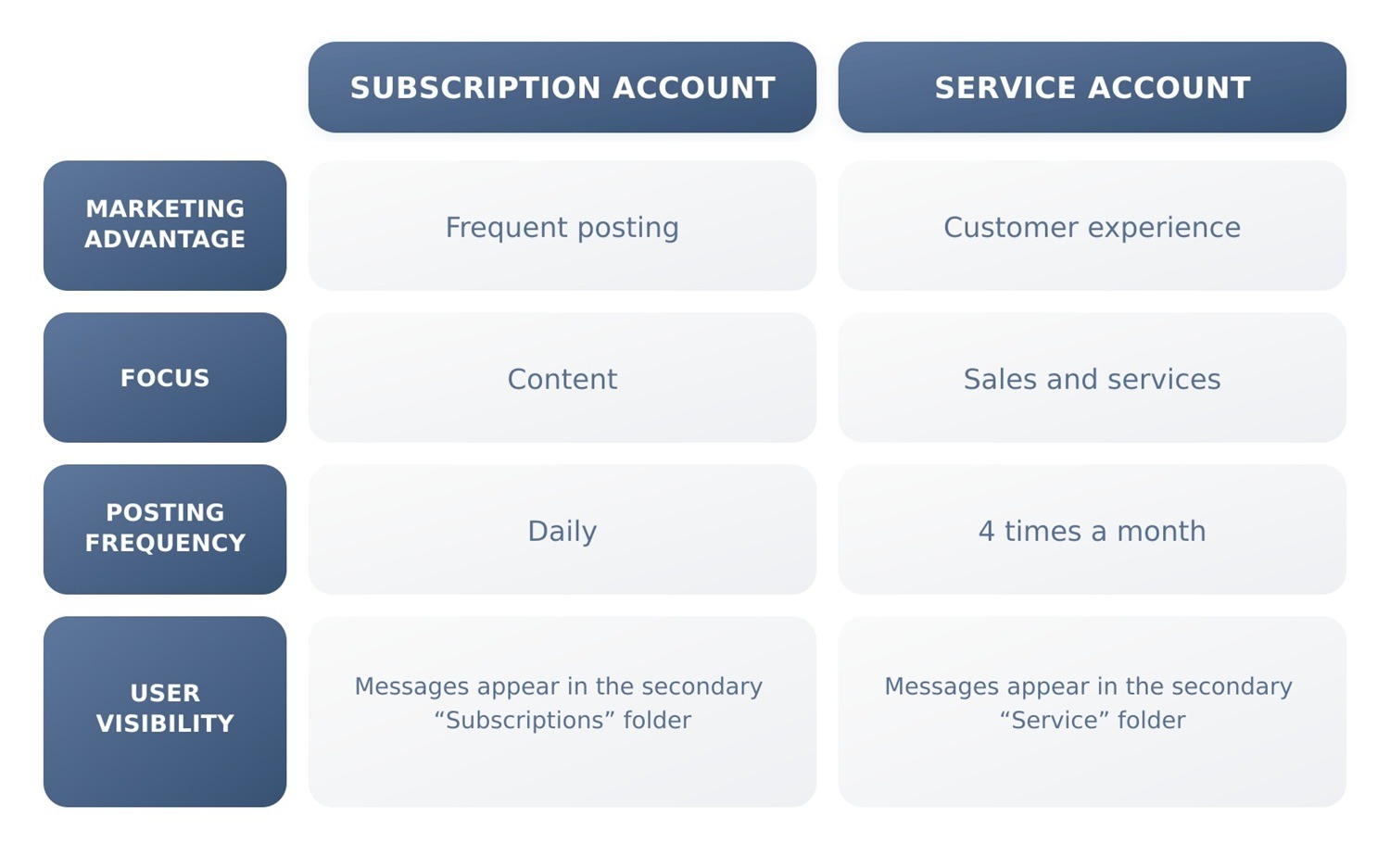
A Subscription Account is designed for companies that are willing to commit to frequent content publishing, using articles, videos, and images. This is a good fit for B2C companies, news or event-based businesses, and individuals trying to build a community. This WeChat corporate account allows you to post one message per day, and content can be re-shared by readers with the original source mentioned or tagged. However, this higher posting frequency comes with lower visibility. Messages and articles do not trigger push notifications and appear in a dedicated “Subscriptions” folder.
In practice, overseas companies usually register a Service Account directly under their foreign entity, while a Subscription Account generally requires a Chinese business license or local registration structure.
Service Accounts
A Service Account is designed for companies and organizations that do not need to share content frequently. This is usually a good fit for B2B companies. For instance, service accounts can support API and geolocation integrations and may also be connected to broader e-commerce and payment functions, depending on the company’s registration structure and setup. Dedicated mini-programs within the service account allow a company to provide broader services and communication channels to its followers, without the need to develop a dedicated app.
In terms of visibility, service accounts face a similar limitation to subscription accounts: messages and articles appear in a special folder within WeChat’s chat list, rather than directly in the main chat feed. For those used to working with WeChat, however, this has become the norm rather than a stumbling block. The main downside is posting frequency, as service accounts allow only four posts per month.
Enterprise Accounts (WeCom)
An Enterprise Account, known as WeCom, is designed as a WeChat-based CRM and internal communication platform that supports business communication, sales and marketing processes, and workflow management.
For marketing and business development purposes, engaging with partners, colleagues, and clients through WeCom helps ensure that business information remains under the company’s control, rather than being held only by individual sales or operations staff. Since WeChat is so widely used in China, often more than email, much of day-to-day business communication takes place on the platform. If the contact information for your clients and partners in China is held only by local staff, this can create a significant operational risk.
Beyond storing contact information in one company-controlled system, WeCom allows marketing teams to send curated content and notifications to specific segments and maintain an overview of business-related communication. Enterprise accounts are also useful for companies that need internal management functions, such as group chats, video meetings, newsletters, and other resource-sharing tools. As a platform, WeCom brings these functions together and makes them available to sales, customer service, and other internal teams.